Horses, Whiskey, and the Poor List: Free People of Color in Scott County
What tax lists, census records, and court minutes tell us about a community that wasn’t supposed to exist.
Virginia’s 1806 manumission law was designed to make communities like this impossible. If you were freed after May 1, 1806, you had twelve months to leave the state. The idea was simple: no free Black population, no challenge to the institution of slavery.
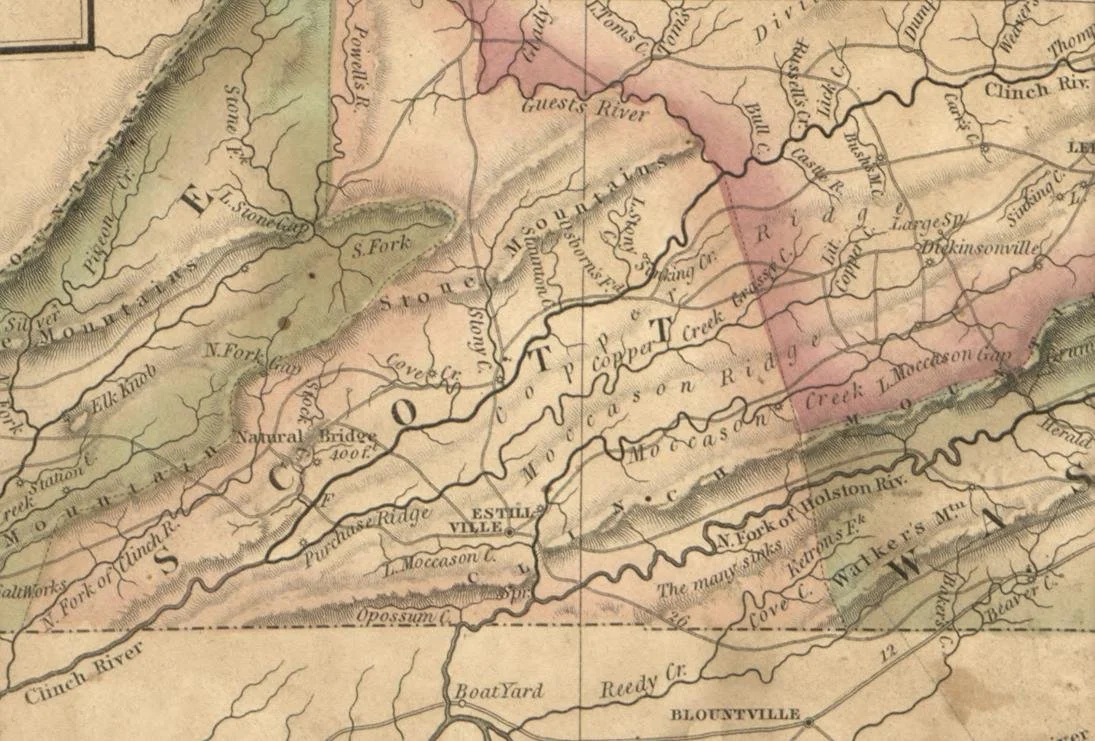
It didn’t work. In 1833, Scott County’s register of free Blacks listed eighteen people across six family groups. They lived on Big Moccasin Creek, Little Moccasin Creek, Copper Creek, Rye Cove, and Guests River. They were laborers, spinsters, and farmers. Some of them had been there for decades.
I’ve spent weeks tracking these families through tax lists, census records, deed books, and court minutes. Here’s what I’ve found.
They Had Horses
This might sound like a small thing, but it’s not. A horse in early nineteenth-century Appalachia was transportation, farm equipment, and social standing all in one. Phillip Ashby had four horses in 1817. Barbara Day had two by 1833. Jacob Wood had one. John Bass had one most years. Edward Grills had one some years and not others.
Tracking horses on the tax lists is like tracking a bank balance. When Phillip Ashby dropped from four horses to two between 1817 and 1818, something happened. When John Bass lost his horse between 1833 and 1834, that’s a setback for a man in his sixties. When Barbara gained her first horse in 1832 and had two by 1833, she was building something. A free woman, head of household, on the tax rolls with property of her own.
They Owned Land
Jacob Wood — listed as a laborer on the 1833 register — owned fifty acres on the north side of Big Moccasin Creek, on the town side of Church Mountain. We know because he sold it in February 1850 to Alexander Willis for one hundred dollars. The deed names Henry Wood as an adjoining landowner, suggesting the Wood family had been on that land long enough to accumulate multiple parcels.
One hundred dollars for fifty acres is two dollars an acre. That’s cheap. Whether it reflects the quality of the land or Jacob’s bargaining position as a free man of color selling to a white buyer, we can’t say. But Jacob signed with his mark — he couldn’t write his name — and the deed says “Jacob Wood a free man of colour” four separate times. The clerk wanted no ambiguity about who was selling.
They Got in Trouble
The year after selling his land, Jacob was indicted for retailing ardent spirits without a license. In plain English: selling whiskey. In August 1851, a jury acquitted him. I like to think he celebrated appropriately.
Running an unlicensed still or selling liquor was common in rural southwest Virginia. The difference is that a free man of color doing it was far more visible and far more vulnerable. Jacob got lucky — or he had good enough standing in the community that no jury was going to convict him. Either way, he beat the charge.
They Grew Old
Samuel Pitman was eighty years old in 1850, still working as a laborer, living alone. John Bass was seventy-seven, farming with his wife Nancy, who was seventy-three. Nancy Cravens was about seventy-nine in the 1840 census, alone, her age column showing a single tick in the “55 to 100” range.
Darkey Wood couldn’t support herself by 1837. Jonathan Wood — relationship unclear — applied to the court to have her placed on the poor list. The overseers of the poor were ordered to provide for her.
There was no Social Security. No pension. No family safety net if your children had left or died or been sold. You worked until you couldn’t, and then you depended on the county or the mercy of neighbors.
They Disappeared
The Ashby family — Phillip, John, James, Lewis — vanishes from the records after 1823. Not on the 1833 register. Not on the tax lists. Not in the census. Four horses, seven household members, a rescue that made the court docket — and then nothing. Did they leave the county? Die? Move to Tennessee like Austin Day? I don’t know yet.
Sealy Wood, Milly Mitchell, Clara Mitchell, Ewel Osborn, Nancy Barney — all appear on the 1833 register and then fade from the records I’ve found so far. Some of these people may turn up in records I haven’t searched yet. Some may be gone for good.
What I’ve Learned
These families were not isolated individuals scattered randomly across the county. They were a community. They lived on the same creeks. They appeared in each other’s court cases. They rescued each other from kidnapping. They testified for and against each other. They sold each other sifters that were too coarse for old corn meal and argued about it for years.
The records that document them are imperfect. Tax commissioners spelled names differently every year. Census enumerators put marks in the wrong columns. Court clerks recorded “Sampson” one year and “Samuel” the next and left us to sort it out two hundred years later.
But the records are there. In the chancery files and minute books and tax lists and deed books and census returns of Scott County, Virginia, and the surrounding counties, these families left their traces. You just have to be willing to look for them, cross-reference relentlessly, and accept that sometimes two yards of tow linen is all the payment a life’s labor leaves behind.
Part 5 of 5 in the Series: “Bound, Free, and In Between: Free People of Color in Scott County, Virginia”
This five part series is based on original research conducted in February–March 2026 using digitized records from FamilySearch, the Library of Virginia’s Chancery Records Index, and the Virginia Untold collection. Profiles for many of the individuals discussed are available or forthcoming on WikiTree. The research is ongoing.